Sunday, June 20, 2010

"prepare them to get fired": why choose a humanities degree?

It seems like every summer there is a collective exhalation of indignant praise for a humanities-heavy education in an attempt to prop-up all those graduates newly released from the safely padded handcuffs of their respective universities. In last Saturday's Globe and Mail, John Allemang interviews Martha Nussbaum about the importance of those overzealously-used, jealously-guarded humanities buzz-words: "critical thinking",  "breadth of knowledge" (see Post-colonialism), and "imagination". Without these skills, particularly the first, there would be no space, it seems, for people with English degrees (or worse, Art History degrees) to cross over into the real world and make money. Thus, every summer we get to read about how important the humanities are, but every fall-winter things seem to rebound so that by summertime we are back where we started. I don't get it. No one is going around telling people that in the humanities they make you memorize lines from Shakespeare and waste four years of your life, but every year that seems to be the exact presupposition that these annual editorials are combatting ONCE AGAIN.


The Globe's Allemang has done an excellent job asking questions that feel new and might give skimming readers pause for thought. He asks, Do you really believe our leaders want us all to improve our critical thinking? Surely a servile populace suits the needs of the many. To which Nussbaum responds,


"For a while they can coast along in that belief, but something blows up in the end. NASA, the space administration, is a good example of that [...] [H]ow a culture of yes-people produced the disaster of the space-shuttle Challenger: you could see the O-rings were dangerous at a certain temperature, but no one was willing to point that out, and they packaged the data the way they thought their leaders would want to hear it.
"Now, NASA has reformed its culture and is much more encouraging of dissent. People are saying that BP and all the other oil companies should take a page out of NASA's book and reform their internal culture."*


...Do you [Nussbaum] feel obliged to prepare them [new Uni grads] for the big surprise when their values of critical thinking don't fit the needs of the workplace?


"I'm giving the graduation address at our law school, and I'm thinking of these wonderful people so full of critical ideas who are going to work for law firms. They'll be under great pressure to narrow themselves [...] So our responsibility is to strengthen the side of personality that wants to stay focused on that goal and help them fight the forces in life, including overwork, that militate against that need."


And finally, my favourite question: And then prepare them to be fired from their law firm for doing so?


"You just have to figure out how you in your particular situation are going to do it. It might be through being a critical voice in your law firm. It might be writing short stories if you can carve out a space. It might be through being a productive alum of your university. Or it might be through bringing up children who can think critically."
***
In addition, UBC's Miranda Burgess reminds us, in an editorial to the Victoria Times Colonist, of the positive aspects of an English degree:

English degree well worth cost
A writer lists "English literature" as a university degree subject with no practical value (June 3). He states that its students should be prevented from borrowing public funds.
Your readers need to know that 96 per cent of BC graduates with English degrees describe themselves as satisfied or very satisfied with their education. Eighty per cent say that the knowledge they gained at university is useful in their working lives. They work in fields ranging from education to corporate communications, advertising, high tech and journalism. They are prepared for further work in fields from law and medicine to business administration.
In light of these facts it's no surprise that former U.S. Treasury secretary Henry Paulson, U.S. Supreme Court Justice Clarence Thomas, Nobel Laureate for medicine Harold Varmus, astronaut Sally Ride, film directors James Cameron and Steven Spielberg, television producer Linda Bloodworth-Thomason, former Disney CEO Michael Eisner, president of BBC America Worldwide Herb Scannell, many writers (including Tom Clancy, Philip Roth, and Stephen King), London Metropolitan Police Commissioner Ian Blair, former U.S. governors Mario Cuomo and Pete Wilson and our own Gordon Campbell all majored in English at university.
Learning to think critically, read incisively and communicate clearly is always practical.

Obviously we all know on whose side I stand. Every summer, at least.
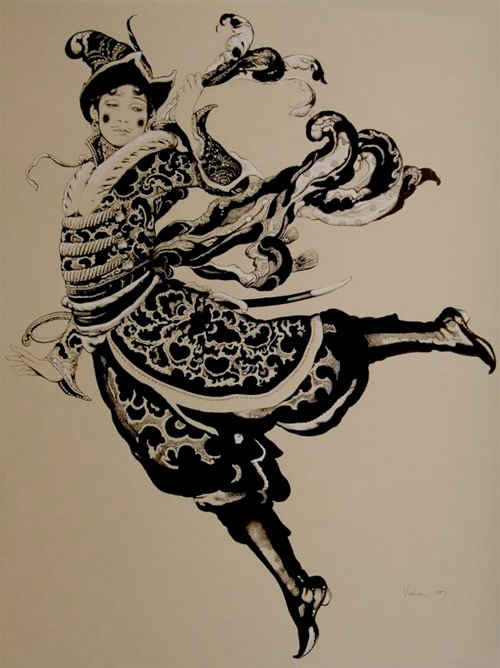


*I wholeheartedly agree that big oil should reform its internal structure, especially its "advisory structure". When you have your own internal advisors working to keep the government happy AND the people who pay you (big oil) happy, there is not a lot of wiggle-room between doing the minimum (for the environment, let's say) and looking to be promoted. Promotions out of advisory roles are often into management positions. Why would big oil promote a dissenting environmental advisor into a management position?

image #1 care of New and Blue Blog, image #2 care of fffound

nonsense language dances

I am reading/trying to read this book, and this is what I get in the Forward:
David Michael Levin explains, “[i]n Das literarische Kunstwerk, translated for the first time, here, into English, Roman Ingarden has employed the powerful method of phenomenology in order to penetrate the underlying ontological essence, or mode of being, of the literary work and to make explicit the corresponding side of subjectivity, within whose structures the underlying modes of givenness peculiar to the literary entity are lawfully established” (xvi).
THAT DOESN'T MAKE ANY SENSE MR.LEVIN. THAT IS UNHELPFUL. WHY DO EVEN YOUR NOUNS SEEM TO ME VERB-LIKE? WTF. This is how literary criticism ceases to be useful: when the subject becomes massively amorphous and the language becomes uberspecific, and between these two things, the work itself ceases to exist. The indefiniteness of the "idea" and the opacity of the language take over, like an interpretive dance inside a waterfall: where everything appears to mean something but actually its just wet nonsense. 


Isn't it the work of the critic to make clear(er) for the reader the big ideas and to use language to his/her advantage? I want distillations of thought, people, not mystical "modes of givenness."

Wednesday, June 16, 2010

in which i realize the homosexual subtext

I mean, I know there's a song about a threesome, but I've loved this musical longtime and have never realized that "Darling Bry," the reluctant Brit, is not just frigid. 
He's carrying on an affair *with the same man* as Sally. 

The kind of story that gets better with age.

Tuesday, June 15, 2010

Academic Bullying: A Problem on College Campuses

When Dr. Faith Edwards found herself facing false accusations that she had tampered with her superior’s car in an attempt to harm him, it became the latest bizarre episode in what she described as a harassment campaign against her. Eventually winning a wrongful termination lawsuit against the Michigan higher education institution where she had been harassed, Edwards, a nursing professor, took her story Thursday to the annual meeting of one of the nation’s largest faculty organizations to spread awareness of “academic bullying” and campus workplace violence.

“It was like drowning and no one sending you a buoy,” said Edwards, who told her story during a session at the American Association of University Professors (AAUP) conference in Washington, D.C.

The disintegration of civility in higher education is a growing concern for university faculty who say the disrespect has reached epic levels not only between professors and students but also among colleagues. Women and faculty of color are often the targets of mistreatment, but increased competition and societal shifts have demonstrated that no higher education professional is immune. In addition to academic bullying, the incidence of workplace violence is no longer rare in higher education. High-profile cases, such as the February killings of three University of Alabama-Huntsville professors allegedly by a co-worker, were prominent in higher education news this past academic year.

“It’s coming up in many of our sessions,” said AAUP director of communications Robin Burns. “It’s always been a problem, but people are really talking about it now.”

“It’s becoming a more prominent issue,” said Janet Tompkins McMahon, a conference presenter and an assistant professor of nursing who is moving to Towson University from Francis Marion University. “We need to be prepared to deal with this and avoid detrimental consequences that could harm everyone.”

Edwards said she believes the bullying she experienced stemmed from a number of reasons. Prior to the car tampering accusations and other incidents, Edwards had been unexpectedly away eight weeks from her job as an assistant professor at her school’s nursing department after suffering a medical emergency. Her absence had put a strain on the department, requiring five different faculty members to cover her classes, she said. But, as soon as she was able, Edwards returned to teaching.

But things had changed. The once popular Edwards was quickly ostracized by her colleagues and pressured by her supervisor to resign. Edwards, who was on track for tenure and held the only doctorate in the department, was berated in faculty meetings, attacked in evaluations, and publicly denigrated in e-mails, she said.

Matters worsened for her, but Edwards battled the offensive that led to her dismissal from the university. A lawyer, an ulcer, and thousands of dollars later, she won her case in court but was not entirely vindicated.

“Your parents always tell you to fight for what you believe is right,” she said, adding that she has decided to use her experience as a case study for academic bullying and to advise others about analyzing the health of institutions. “But it’s damn hard.”

And for professors teaching the millennial generation, good manners are no longer the norm among students, McMahon said, adding that young people today feel entitled to everything—even grades they don’t deserve. Asking for extra credit, complaining about assignment deadlines, making excuses for incomplete work are characteristic of modern students, she added.

To adjust to her students’ learning styles and remain sensitive to their needs, McMahon characterized them as Wizard of Oz archetypes, which are the confused scarecrow, the insecure Tin Man, the cowardly lion, and the focused Dorothy. Understanding student personalities, she said, helps professors avoid triggering behaviors that could lead to potentially dangerous stress in the classroom.

“Be careful. A house could fall on you,” McMahon said, alluding to the fate of the wicked witch in the Wizard of Oz.

In a 2005 study published in the Journal of Nursing Education, researchers reported examples of increased problematic behavior, everything from leaving class early or sleeping in class to verbal abuse and plagiarism.

Presenters at the AAUP sessions on academic bullying suggested instructors develop standards of practices that are consistent and published clearly in course syllabi with explicit wording that emphasizes strict adherence. If the behavior is not immediately confronted and reported, the incivility could escalate, presenters said.

Paul Howe, a conference presenter and business instructor at Caldwell Community College and Technical Institute in North Carolina, said he believes the audacity of his students’ excuses and classroom behavior is tied to the societal emphasis on consumerism.

“Students often ask me why they aren’t passing if they pay for classes and come every day,” Howe said. “They actually think, since they pay, they should get good grades without doing the work.”

From: http://diverseeducation.com

...the only excuse for making a useless thing is that one admires it intensely...


"The studio was filled with the rich odor of roses, and when the light summer wind stirred amidst the trees of the garden there came through the open door the heavy scent of lilac, or the more delicate perfume of the pink flowering thorn." 
Oscar Wilde, The Picture of Dorian Gray


Sophie Srej by Wendy Bevan for Marie Claire Italia, June 2010, via Fashion Gone Rogue

Monday, June 14, 2010

You can just tell that Eugenides was reading Nabokov when he wrote The Virgin Suicides. That book steeps slow omnivorous language through pores of neologisms and words resurrected from antiquity; from Nabokov, Eugenides stole mood lighting and made it fierce and mysterious.

Now, in this curious collection, Eugenides curates love stories from giddy to grotesque, West to East, Alice Munro to Chekov. But the Nabokov is the ligature binding this body of work. The story is called "Spring in Fialto," and recalls in that fuzzy-yet-crystal clear Nabokovian manner the coincidental and fleeting meetings of Nina and Victor, two Russian expats. Now engaged to other people, now broken up with or married to other people, now unhappy with other people, the two invariable suspend the litigiousness of their lives and fall outside boundaries and into each other. And it's all so slippery:

"I call her Nina, but I could hardly have known her name yet, hardly could we have had time, she and I, for any preliminary; "Who's that?" she asked with interest-- and I was already kissing her neck, smooth and quite fiery hot from the long fox fur of her coat collar, which kept getting into my way until she clasped my shoulder, and with the candor so peculiar to her gently fitted her generous, dutiful lips to mine" (235).

You barely know that they are meeting for the first time before he's kissing her. I had to re-read the passage and try to figure out where they were: alone? outside? still in the parlor with all the rest of the people? And then there's the peculiarity of her response: candor, and generous, dutiful lips. Lips that are used to being kissed, and know what it is to do in such a situation. Generous because they are free to pull away?

Conclusion: read this.

first-class wasp murderer

that's me